Sonova Wholesale Raises Outlook as Hearing Aid Sales Rise 11%
Phonak Virto R and Infinio Ultra helped drive first-half growth, with EON adding momentum late in the period. Cochlear implant sales fell 10.2%.
Hearing aid glossary
Looking that up…
Terms are matched automatically. A definition may not fit every context.

Sonova, the Swiss parent company of Phonak and Unitron, reported on November 12 that it has raised its full-year outlook after double-digit wholesale hearing aid growth lifted first-half sales and operating profit above analyst expectations. Revenue from continuing operations reached CHF 1.83 billion (US$2.20 billion) for the 6 months ended September 30, 2026, up 7.5% at constant exchange rates. Sonova classifies its Consumer Hearing business, including its planned sale of Sennheiser, as discontinued operations.
Sonova CEO Eric Bernard in a press releaseOur innovation leadership is delivering meaningful advances in hearing performance and experience with EON, Roger On Sphere, and Integro. EON is already contributing above our expectations, combining superior acoustics in a smaller device with best-in-class connectivity— its launch across our markets supported growth and market share gains.

Core operating profit (EBIT), which excludes certain special items, rose 22.9% at constant exchange rates to CHF 384 million (US$461 million). The core EBIT margin increased to 20.9% from 18.4% a year earlier. Reported EBIT reached CHF 372 million (US$447 million).
Sonova now expects fiscal 2026/27 sales to grow 6-8%, up from 5-8%, and core EBIT to rise 10-13%, up from 7-10%, both at constant exchange rates. It also lifted its estimate for full-year hearing aid market growth to 3-5% from 2-4%.
Phonak’s new launches build on wholesale gains
Hearing Instrument sales increased 9% to CHF 1.72 billion (US$2.06 billion). Wholesale sales rose 11% to CHF 968.1 million (US$1.16 billion) as Sonova sold more devices at higher average prices. The company reported its 11th consecutive quarter of year-over-year wholesale market share gains.


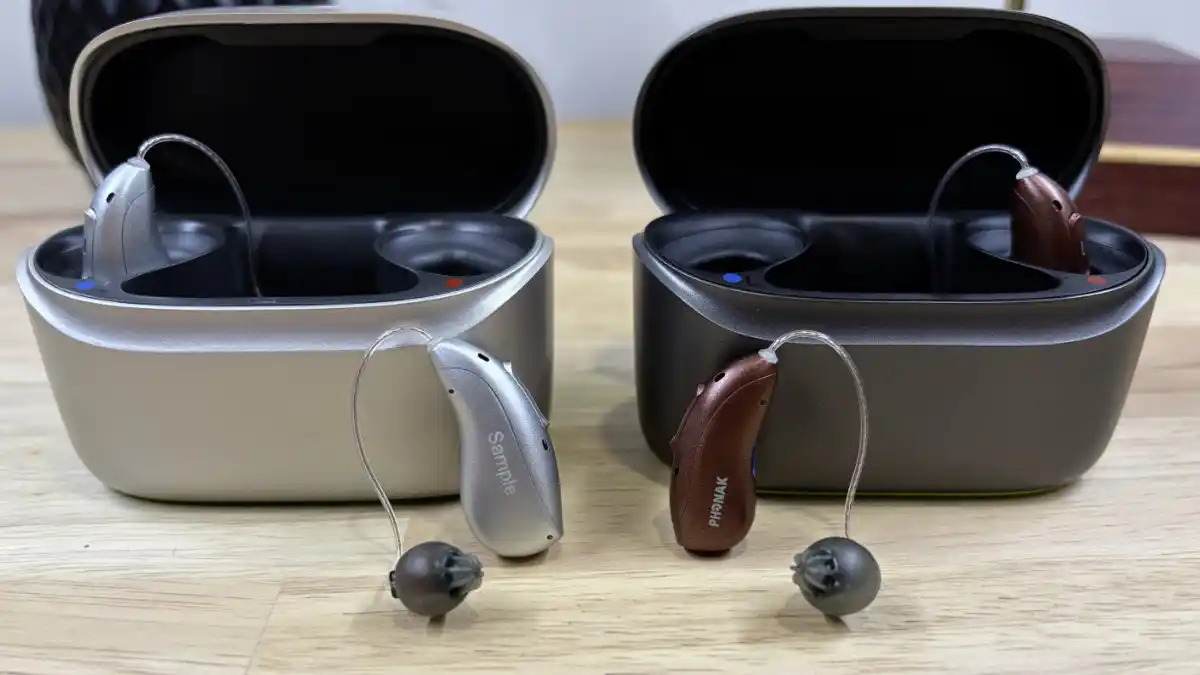
Phonak’s rechargeable Virto R custom hearing aids and Infinio Ultra supported growth, while the Audéo EON platform contributed late in the half. The United States was the largest contributor to wholesale growth, helped by expanded relationships with major customers and higher deliveries to the Department of Veterans Affairs (), according to the company.
Retail revenue, which includes AudioNova/Connect and newly acquired GEERS, rose 6.5% at constant exchange rates to CHF 748.6 million (US$899 million), including 5.2% organic growth and 1.3 percentage points from acquisitions.
Cochlear implant sales fell 10.2% at constant exchange rates to CHF 117.4 million (US$141 million). Sonova cited weaker implant system sales in the US and in China, where volume-based procurement took effect, and fewer processor upgrades ahead of the Advanced Bionics Integro launch. Integro was introduced in Europe in October, and Sonova’s November report said US availability was pending approval.

Market analysts at Bernstein and DNB Carnegie Research were encouraged by Sonova’s first-half results and saw room for further gains. Bernstein’s Susannah Ludwig and colleagues highlighted the strength of the wholesale hearing aid business, while DNB Carnegie’s Niels Leth pointed to better-than-expected profitability.
When comparing other companies in the hearing industry, Demant posted 17% organic growth in external hearing aid sales in calendar Q3, helped by Oticon Reveal and Zeal, while GN Hearing grew 5% organically following the ReSound Sensia launch. WSA’s wholesale revenue was flat organically in its September quarter and fell 3% for its full fiscal year, even as group organic revenue grew 2%. It should be noted that these figures cover different reporting periods and sales channels.
In retail, Sonova’s 5.2% first-half organic growth compares with 6% for Demant’s Hearing Care business and 3.6% for Amplifon in the third quarter.
Karl Strom
Editor in ChiefKarl Strom is the editor-in-chief of HearingTracker. He was a founding editor of The Hearing Review and has covered the hearing aid industry for over 30 years.